


Bihar, Northeastern India
Pala period, 11th century
Hard black basalt
W61 x H43 cm
Art Loss Register Certificate: S 00021601
Private collection, Canada
Collection Marcel Nies, Antwerp, 2009-2014
Published: The future Buddha, the cultural heritage of Asia, Marcel Nies Oriental Art, Antwerpen, 2009, pp.30-31
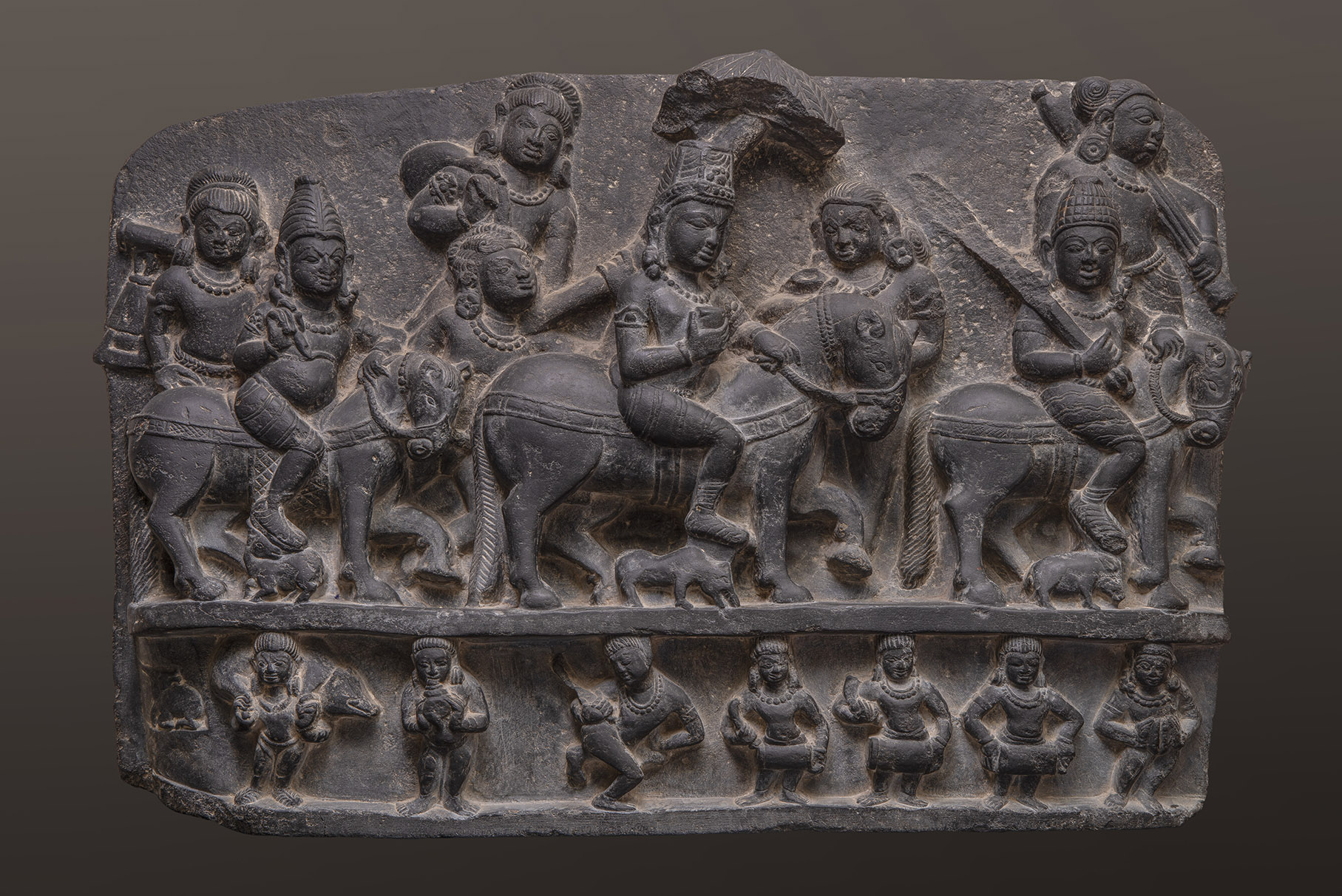
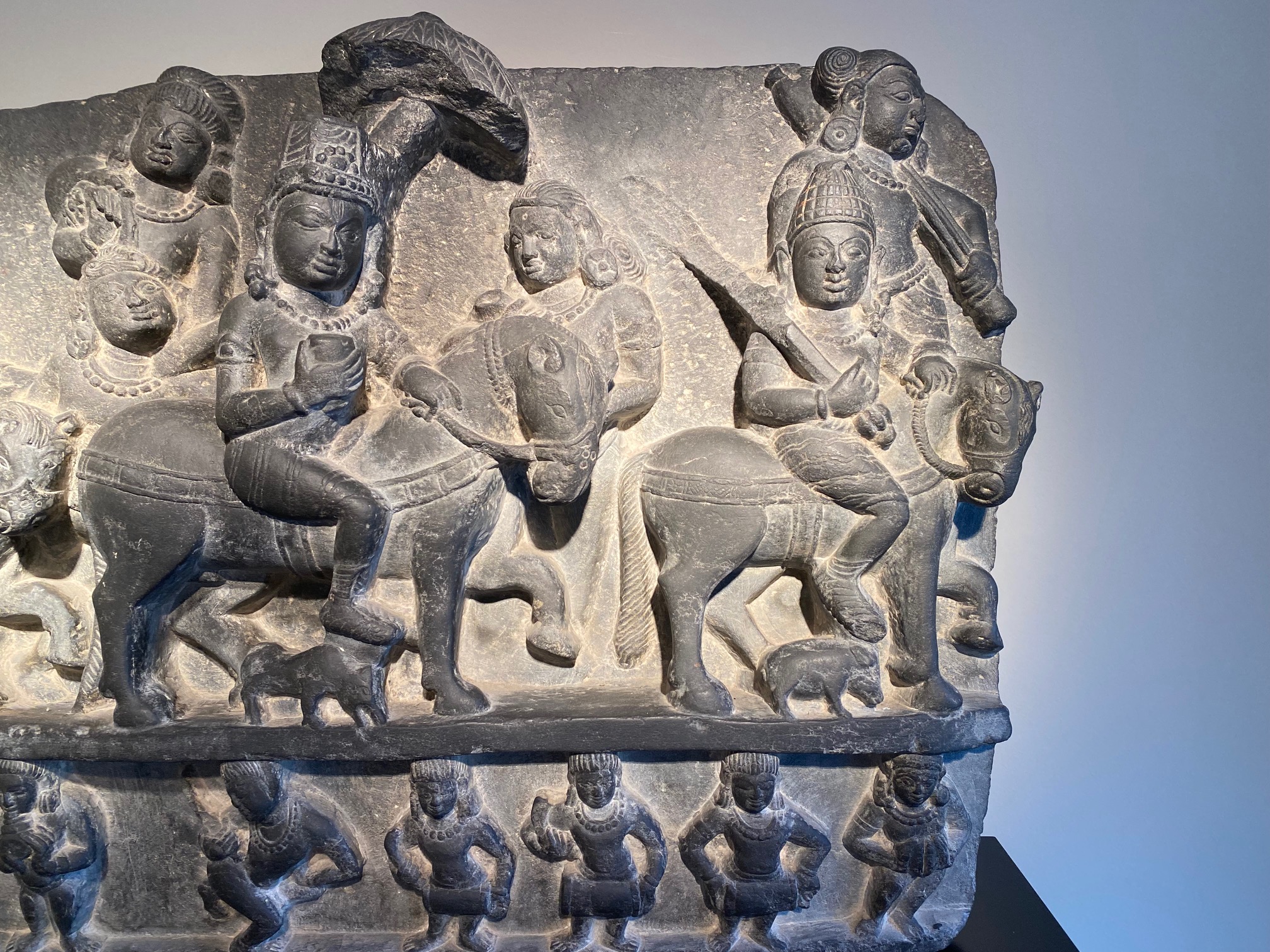
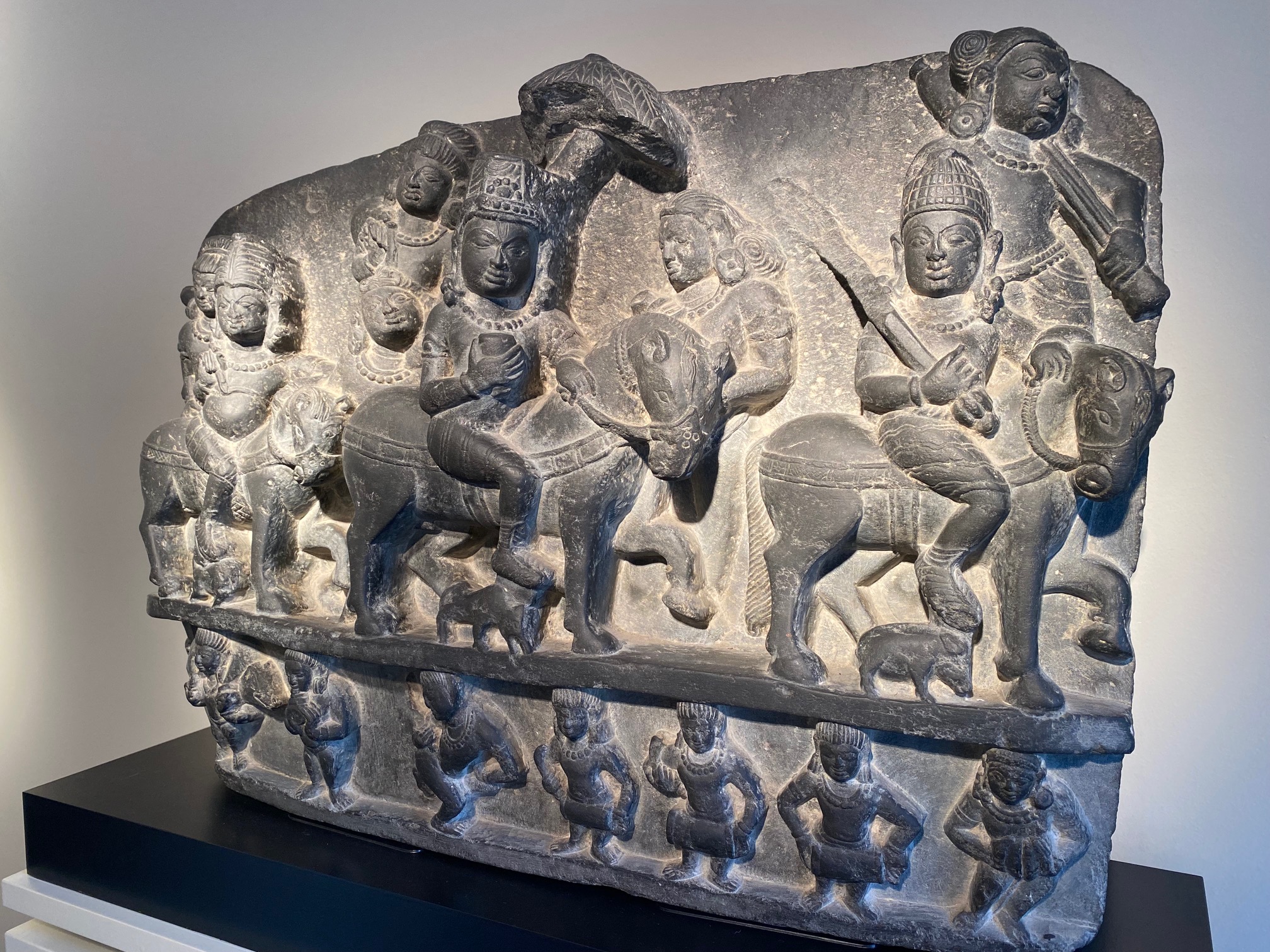
This finely carved basalt relief represents Revanta, the divine hunter and son of the solar deity Surya, a figure venerated particularly in eastern India during the Pala period (8th–12th century). The composition is divided into two horizontal registers, the upper one depicting a dynamic equestrian scene and the lower one showing a rhythmic procession of attendants.
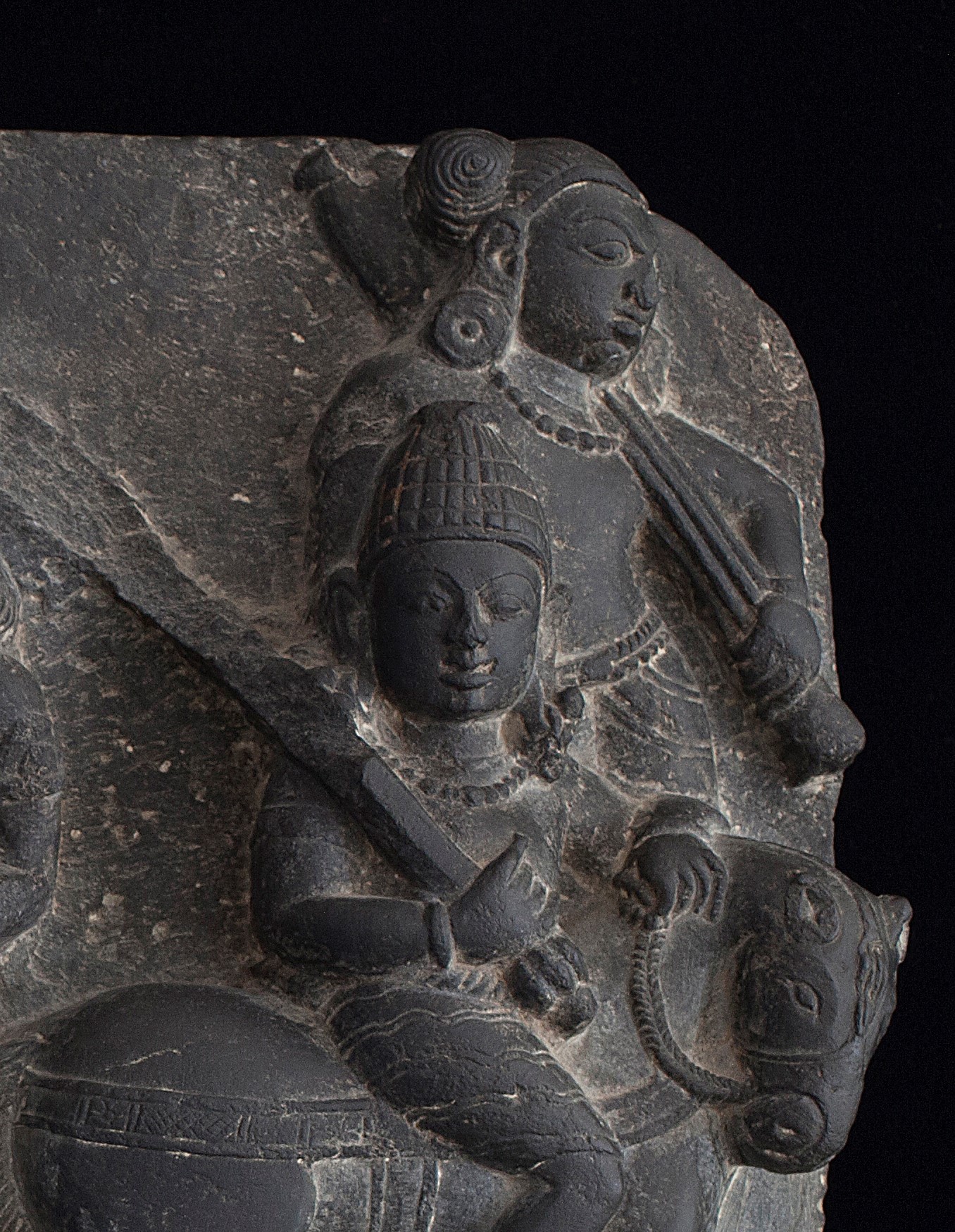
In the background are two of Revanta’s attendants, one bearing a parasol, the other approaching the god with a wine jar in his hand. Revanta wears a dhoti secured with a girdle and high boots similar to those of his father Surya. He gathers his reins in his left hand and holds a cup of wine in his right. One attendant carries a bow and arrow, while several animals are shown trampled beneath the horses’ hooves. The lower register portrays a line of standing and dancing musicians, whose rhythmic postures lend a ceremonial liveliness to the composition. The composition also evokes a lively hunting scene, accompanied by dance and music. From left to right are a running deer, an attendant carrying a dead boar on his shoulders, a musician, a dancer, three drummers and a man playing cymbals. Music was an essential element of the hunt in ancient India.
Revanta was a very popular figure in Bihar during the Pala period, as several stone representations have been found. By the 10th Century in East India and Gujarat Revanta became the patron deity of horse traders, warriors and horses, and is thought to protect mankind against the dangers of the forest, which may explain his increasing popularity. Revanta is the youngest son of the Hindu sun god Surya and his wife Sanjna. He is a divine hunter and king of the Guhyakas.
This relief was probably placed in a niche on the external wall of a temple dedicated to the sun god Surya. It is a beautiful representation of a mythological subject and served as a record of a princely past.
The Pala kings between the 8th-12th century founded a great number of sanctuaries, Bodhgaya, Nalanda and Kurkihar, and created one of the richest artistic traditions of Asia. The elaborate rendering of the ornaments of Revanta is characteristic of Pala sculpture of the 11th century. This relief is sculpted with a lot of dynamism and action, as the hunt is in progress. The figures and animals are distributed over different compartments to create animation and a keen visual perception. The use of hard dark basalt is typical of this period.
References:
A Pala relief of the 10th century with Revanta can be seen in Asian Art at the Norton Simon Museum, Volume 1, Art from the Indian Subcontinent, Pratapaditya Pal, 2003, Mapin Publishing, in association with Yale University press, p.180.
A relief with the central figure of Revanta, ca.1200, stone, can be seen in Brooklyn Museum, USA
Relief with Revanta, Bihar, circa 11th century, black stone, can be seen in the Indian Museum of Kolkata


Privacy Document | Reset Cookieconsent
Website by Phobos & Actor